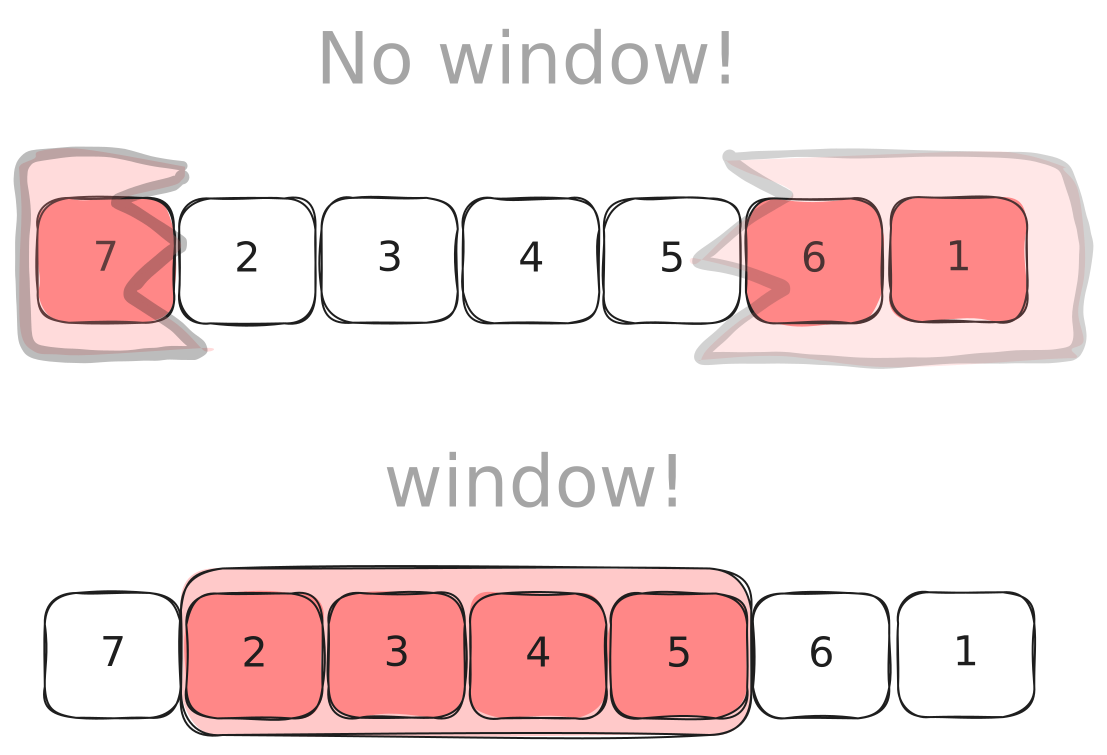
We previously learned about the fixed-length sliding window technique, which typically involves sliding one element at a time. For a detailed explanation, refer to the article —— 📝How to Solve Fixed-Length Sliding Window Problems. Now, we encounter a new problem that also appears solvable with a sliding window, but with a slight twist🔗.
A Tricky Problem
There are several cards arranged in a row, and each card has an associated number of points. The points are given in the integer array cardPoints.
In one step, you can take one card from the beginning or from the end of the row. You have to take exactly k cards.
Your score is the sum of the points of the cards you have taken.
Given the integer array cardPoints and the integer k, return the maximum score you can obtain.
Example:
Input: cardPoints = [7,2,3,4,5,6,1], k = 3
Output: 14
Explanation: The optimal strategy is to take the first card on the left (7) and the two cards on the right (1 then 6), resulting in a score of 7 + 1 + 6 = 14.
Constraints:
- $1 <= cardPoints.length <= 10^5$
- $1 <= cardPoints[i] <= 10^4$
- $1 <= k <= cardPoints.length$
This problem aligns with the three key characteristics of fixed-length sliding window problems: Constant Window Size, Sequential Movement, and Efficiency Goal.
The only challenge is that the k elements are not necessarily consecutive in the original array. It’s tricky to track k elements that can be taken from either end.
Reverse Thinking
Since forward thinking isn’t straightforward, we can try reverse thinking.
Let m = cardPoints.length - k (note that m can be 0). We take k cards, leaving m cards.
Since the total points are fixed, maximizing the points taken is equivalent to minimizing the points left. Because we can only take from the ends, the remaining cards must be consecutive. Thus, the problem becomes:
Find the minimum sum of a contiguous subarray of length m,
which can be efficiently solved with a fixed-length sliding window.
const maxScore = (cardPoints, k) => {
  const n = cardPoints.length
  const m = n - k // Cards to leave in window (can be 0)
  let windowSum = 0

  // Step 1: Calculate initial window sum (cards 0 to m-1)
  for (let i = 0; i < m; i++) {
    windowSum += cardPoints[i]
  }

  let totalSum = windowSum // Will become sum of all cards
  let minWindowSum = windowSum // Track minimum window sum found

  // Step 2: Slide the window
  for (let i = m; i < n; i++) {
    // Update total sum with current card
    totalSum += cardPoints[i]
    // Slide window: add new right element, remove left element
    windowSum += cardPoints[i] - cardPoints[i - m]
    // Record the minimum window sum found so far
    minWindowSum = Math.min(minWindowSum, windowSum)
  }

  // Max points = Total points - Minimum window sum
  return totalSum - minWindowSum
}
We can also use the In-Update-Out pattern, with a special condition to handle the case when the window size is zero (i.e., when n equals k).
const maxScore = (cardPoints, k) => {
  const n = cardPoints.length
  const m = n - k
  let totalSum = 0
  let windowSum = 0
  let minWindowSum = Infinity

  for (let i = 0; i < n; i++) {
    totalSum += cardPoints[i]

    // Step 1: In
    windowSum += cardPoints[i]

    const left = i - m + 1
    if (left < 0) {
      continue
    }

    // Step 2: Update
    minWindowSum = Math.min(minWindowSum, windowSum)

    // Step 3: Out
    windowSum -= cardPoints[left]
  }

  // If n equals k, we take all cards, so return totalSum
  // Otherwise, return totalSum - minWindowSum
  return n === k ? totalSum : totalSum - minWindowSum
}
Complexity Analysis
- Time complexity: O(n), where n is the length of cardPoints.
- Space complexity: O(1)
Alternative Approaches
1. Forward Thinking
While the reverse-thinking approach is more intuitive, forward thinking can also be applied directly.
The key insight is that the optimal solution must be one of the following k + 1 combinations:
| Left Cards | Right Cards | Window Composition |
|---|---|---|
| k | 0 | First k elements |
| k-1 | 1 | First (k-1) + last 1 element |
| k-2 | 2 | First (k-2) + last 2 elements |
| … | … | … |
| 1 | k-1 | First 1 + last (k-1) elements |
| 0 | k | Last k elements |
Approach 1: Backward Sliding Window
We can slide the window backward, starting with all k cards from the left, and gradually replace left cards with right cards.
This looks like the window slides backward through the virtual concatenated array [last k elements] + [first k elements].
const maxScore = (cardPoints, k) => {
  let windowSum = 0
  // Initial window: first k elements (all from left)
  for (let i = 0; i < k; i++) {
    windowSum += cardPoints[i]
  }

  let maxSum = windowSum
  // Slide backward: replace one left card with one right card at a time
  for (let i = 1; i <= k; i++) {
    // Replace the (k-i)th card from the left with the ith card from the right
    windowSum += cardPoints[cardPoints.length - i] - cardPoints[k - i]
    maxSum = Math.max(maxSum, windowSum)
  }
  return maxSum
}
Approach 2: Forward Sliding Window
Similarly, we can slide forward by starting with the last k cards and gradually replacing right cards with left cards.
const maxScore = (cardPoints, k) => {
  const n = cardPoints.length
  let windowSum = 0
  // initial window: last k elements (all from right)
  for (let i = n - k; i < n; i++) {
    windowSum += cardPoints[i]
  }

  let maxSum = windowSum
  // Slide forward: replace one right card with one left card at a time
  for (let i = 0; i < k; i++) {
    windowSum += cardPoints[i] - cardPoints[n - k + i]
    maxSum = Math.max(maxSum, windowSum)
  }
  return maxSum
}
Alternatively, we can explicitly simulate sliding through the virtual concatenated array [last k elements] + [first k elements]:
const maxScore = (cardPoints, k) => {
  const n = cardPoints.length
  let maxSum = 0,
    windowSum = 0

  for (let i = n - k; i < n + k; i++) {
    let index = i % n
    windowSum += cardPoints[index]

    if (i < n - 1) {
      continue
    }

    maxSum = Math.max(maxSum, windowSum)

    windowSum -= cardPoints[(i - k + 1) % n]
  }

  return maxSum
}
Complexity Analysis
- Time complexity: O(k) - Each approach processes at most 2k elements
- Space complexity: O(1)
Building on the sliding concept from forward thinking, we can use a more direct method: create the concatenated array directly.
This method clearly demonstrates that selecting k cards from the ends is equivalent to finding the maximum sum of k consecutive elements in the array [last k elements] + [first k elements].
const maxScore = (cardPoints, k) => {
  const n = cardPoints.length
  // Construct concatenated array: [last k elements] + [first k elements]
  const concatenated = cardPoints.slice(n - k).concat(cardPoints.slice(0, k))
  let maxSum = 0,
    windowSum = 0

  for (let i = 0; i < k * 2; i++) {
    windowSum += concatenated[i]

    if (i < k - 1) {
      continue
    }

    maxSum = Math.max(maxSum, windowSum)

    windowSum -= concatenated[i - k + 1]
  }

  return maxSum
}
Complexity Analysis
- Time complexity: O(k) - Processes 2k elements
- Space complexity: O(k) - Creates a new array of size 2k
Now you’re ready to slide into your next coding challenge with confidence. Happy coding! ✨